|
|
USA Ranks Last In Health Care - Again
 Bahamut.Kara Bahamut.Kara
Server: Bahamut
Game: FFXI
Posts: 3544
By Bahamut.Kara 2014-06-17 02:35:55
The reason why healthcare is unaffordable in America is that we are funding nearly the entire R&D of the world. ANything to support this though? I see this repeated often and it doesn't sound completely implausible, but what keeps R&D costs within the US only?
It's not true.
The US spends the most as a country currently but it does not spend the majority of medical or total R&D in the world. Historically this was true but this started changing many years ago.
Here's a recent article specifically about biomedical, with some other areas are mentioned.
http://www.usnews.com/news/articles/2014/01/02/us-medical-research-spending-drops-while-asia-makes-gains
Edit: but I don't know why this is brought up as part of the debate on healthcare costs. As far as I know healthcare costs and R&D are two seperate categories
[+]


By Altimaomega 2014-06-17 03:04:06
The reason why healthcare is unaffordable in America is that we are funding nearly the entire R&D of the world. ANything to support this though? I see this repeated often and it doesn't sound completely implausible, but what keeps R&D costs within the US only?
It's not true.
The US spends the most as a country currently but it does not spend the majority of medical or total R&D in the world. Historically this was true but this started changing many years ago.
Here's a recent article specifically about biomedical, with some other areas are mentioned.
http://www.usnews.com/news/articles/2014/01/02/us-medical-research-spending-drops-while-asia-makes-gains
Edit: but I don't know why this is brought up as part of the debate on healthcare costs. As far as I know healthcare costs and R&D are two seperate categories
Just like oil gas and diesel prices do not effect the rise in cost of anything right? /sigh
So Kingnobody, do you think these people are just playing with us because they are bored or do you think they are just this stupid? Its like the most blatantly obvious things need to be pointed out to them. However, even then they claim the opposite of rationality. Then they call us crazy..
 Cerberus.Pleebo Cerberus.Pleebo
Server: Cerberus
Game: FFXI
Posts: 9720
By Cerberus.Pleebo 2014-06-17 03:18:05
I asked a simple question. Dunno why you're being a ***.
Thanks Kara!
[+]

Cerberus.Tikal
Server: Cerberus
Game: FFXI
Posts: 4947
By Cerberus.Tikal 2014-06-17 03:51:01
The only way he can rationalize his base world-view is by fitting others into a category that doesn't challenge his perception of the world. The fact that he's unwilling to compromise anything, or engage anyone in actual discourse, is the perfect indicator of it. Simply disagreeing with him makes you stupid, despite the fact that there are a ridiculous amount of intelligence types, perspectives, and angles; he's superior to all of them.
Bahamut.Kara
Server: Bahamut
Game: FFXI
Posts: 3544
By Bahamut.Kara 2014-06-17 04:25:28
The reason why healthcare is unaffordable in America is that we are funding nearly the entire R&D of the world. ANything to support this though? I see this repeated often and it doesn't sound completely implausible, but what keeps R&D costs within the US only?
It's not true.
The US spends the most as a country currently but it does not spend the majority of medical or total R&D in the world. Historically this was true but this started changing many years ago.
Here's a recent article specifically about biomedical, with some other areas are mentioned.
http://www.usnews.com/news/articles/2014/01/02/us-medical-research-spending-drops-while-asia-makes-gains
Edit: but I don't know why this is brought up as part of the debate on healthcare costs. As far as I know healthcare costs and R&D are two seperate categories
Just like oil gas and diesel prices do not effect the rise in cost of anything right? /sigh
So Kingnobody, do you think these people are just playing with us because they are bored or do you think they are just this stupid? Its like the most blatantly obvious things need to be pointed out to them. However, even then they claim the opposite of rationality. Then they call us crazy..
Energy costs you can can directly account for. R&D would be an indirect cost and how much it affects costs would be interesting to see.
If you could show me where increased r&d accounts for our raised healthcare costs i'd like to read it....which is why i mentioned it.
Bahamut.Kara
Server: Bahamut
Game: FFXI
Posts: 3544
By Bahamut.Kara 2014-06-17 04:49:24
Well according to an insurance company this is the breakdown in costs
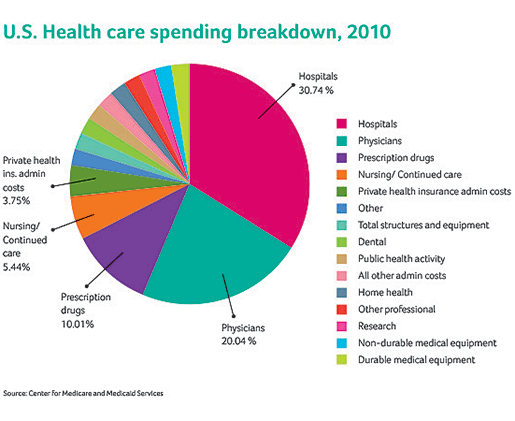
Research 4%~ (generous estimate) and if we addprescription drugs that's a total of 14.01%.not even close to the majority of costs.
http://www.aetna.com/health-reform-connection/aetnas-vision/facts-about-costs.html
Quote: Health care spending in the United States totaled nearly $2.6 trillion in 2010. Of total spending, half (51 percent) goes to pay the cost of medical services provided by hospitals and physicians. Prescription drugs spending accounts for 10 percent. While prescription drug costs represent a significant portion of overall health spending, this is one area where there has been some recent success in slowing the growth in spending. From 2009 to 2010, prescription drug costs grew by just 1.2 percent while hospital and physician costs grew by 4.9 percent.
...
hospital spending in the U.S. is more than 60 percent higher. Spending on physicians, specialists and dentists is almost 2 ½-times higher than in other OECD countries.
...
An increasingly important factor driving hospital price increases is consolidation of the hospital industry. Hospital mergers and acquisitions jumped by 33 percent between 2009 and 2010. Research shows that hospital market concentration leads to increases in the price of hospital care. In fact, price increases exceeded 20 percent when mergers occurred in concentrated markets.
...
Wasteful spending likely accounts for between one-third and one-half of all U.S. health care spending. PricewaterhouseCoopers calculates that up to $1.2 trillion, or half of all health care spending, is the result of waste.
[+]
By fonewear 2014-06-17 06:41:37
Well according to an insurance company this is the breakdown in costs
Research 4%~ (generous estimate) and if we addprescription drugs that's a total of 14.01%.not even close to the majority of costs.
http://www.aetna.com/health-reform-connection/aetnas-vision/facts-about-costs.html
Quote: Health care spending in the United States totaled nearly $2.6 trillion in 2010. Of total spending, half (51 percent) goes to pay the cost of medical services provided by hospitals and physicians. Prescription drugs spending accounts for 10 percent. While prescription drug costs represent a significant portion of overall health spending, this is one area where there has been some recent success in slowing the growth in spending. From 2009 to 2010, prescription drug costs grew by just 1.2 percent while hospital and physician costs grew by 4.9 percent.
...
hospital spending in the U.S. is more than 60 percent higher. Spending on physicians, specialists and dentists is almost 2 ½-times higher than in other OECD countries.
...
An increasingly important factor driving hospital price increases is consolidation of the hospital industry. Hospital mergers and acquisitions jumped by 33 percent between 2009 and 2010. Research shows that hospital market concentration leads to increases in the price of hospital care. In fact, price increases exceeded 20 percent when mergers occurred in concentrated markets.
...
Wasteful spending likely accounts for between one-third and one-half of all U.S. health care spending. PricewaterhouseCoopers calculates that up to $1.2 trillion, or half of all health care spending, is the result of waste.
Is that a cherry pie chart or a apple pie chart ?
Bahamut.Kara
Server: Bahamut
Game: FFXI
Posts: 3544
By Bahamut.Kara 2014-06-17 07:10:15
 Leviathan.Chaosx Leviathan.Chaosx
Server: Leviathan
Game: FFXI
Posts: 20284
By Leviathan.Chaosx 2014-06-17 07:13:44
How does the ACA fit into that now?
By fonewear 2014-06-17 07:14:33
How does the ACA fit into that now?
It is the sugar high you get after eating the pie chart.
Server: Asura
Game: FFXI
Posts: 34187
By Asura.Kingnobody 2014-06-17 07:38:16
Energy costs you can can directly account for. R&D would be an indirect cost and how much it affects costs would be interesting to see.
If you could show me where increased r&d accounts for our raised healthcare costs i'd like to read it....which is why i mentioned it. Indirect only to the total cost of healthcare, and only if you use cost accounting. Which only applies to manufacturing companies.
Yes, manufacturing companies do use research and development to produce better products, but last I saw, healthcare is a service industry.
Unless you assume that pharmaceuticals = all of the healthcare industry which nobody does.
But I wouldn't expect an "economist" or whatever you do to know that.
Well according to an insurance company this is the breakdown in costs
Research 4%~ (generous estimate) and if we addprescription drugs that's a total of 14.01%.not even close to the majority of costs.
http://www.aetna.com/health-reform-connection/aetnas-vision/facts-about-costs.html
Quote: Health care spending in the United States totaled nearly $2.6 trillion in 2010. Of total spending, half (51 percent) goes to pay the cost of medical services provided by hospitals and physicians. Prescription drugs spending accounts for 10 percent. While prescription drug costs represent a significant portion of overall health spending, this is one area where there has been some recent success in slowing the growth in spending. From 2009 to 2010, prescription drug costs grew by just 1.2 percent while hospital and physician costs grew by 4.9 percent.
...
hospital spending in the U.S. is more than 60 percent higher. Spending on physicians, specialists and dentists is almost 2 ½-times higher than in other OECD countries.
...
An increasingly important factor driving hospital price increases is consolidation of the hospital industry. Hospital mergers and acquisitions jumped by 33 percent between 2009 and 2010. Research shows that hospital market concentration leads to increases in the price of hospital care. In fact, price increases exceeded 20 percent when mergers occurred in concentrated markets.
...
Wasteful spending likely accounts for between one-third and one-half of all U.S. health care spending. And how much does the world in total spend on research and development again?
Because, if you read what I stated:
The reason why healthcare is unaffordable in America is that we are funding nearly the entire R&D of the world.
You didn't exactly do anything but prove my point.
Quote: PricewaterhouseCoopers calculates that up to $1.2 trillion, or half of all health care spending, is the result of waste.
Correct. But to PWC, waste is considered to be unproductive research. Meaning research that ended up being proven ineffective or incorrect.
Others may see that to be learning what is not right. But to each his own.
Server: Bahamut
Game: FFXI
Posts: 5381
By Bahamut.Baconwrap 2014-06-17 12:35:45
Research 4%~ (generous estimate) and if we addprescription drugs that's a total of 14.01%.not even close to the majority of costs.
Prescription costs will vary immensely, b/c afterall not every healthcare scenario requires a hospital visit.
Is the issue an acute one or chronic? Does the patient require a simple antibiotic like azithromycin? or is it something resistant that requires vancomycin?
The lifespan costs for an individual with a chronic condition like HIV, Hepatitis, Cancer, Diabetes are going be a lot more money than an acute issue that requires one visit to the hospital.
One of the links I posted back estimated that with current costs on just hepatitis medication(Sovaldi) it would be 85k annually(before insurance coverage). That is not including the costs of the infectious disease specialist and/or the hepatologist.
[+]
Bahamut.Milamber
Server: Bahamut
Game: FFXI
Posts: 3692
By Bahamut.Milamber 2014-06-17 13:33:23
Correct. But to PWC, waste is considered to be unproductive research. Meaning research that ended up being proven ineffective or incorrect. That is utterly false, given the report prrovided by PWC itself. Nowhere is any reference to research or R&D costs being any component of the 1.2trillion waste estimate.
[+]
Bahamut.Milamber
Server: Bahamut
Game: FFXI
Posts: 3692
By Bahamut.Milamber 2014-06-17 13:41:33
Bahamut.Baconwrap said: »Research 4%~ (generous estimate) and if we addprescription drugs that's a total of 14.01%.not even close to the majority of costs.
Prescription costs will vary immensely, b/c afterall not every healthcare scenario requires a hospital visit.
Is the issue an acute one or chronic? Does the patient require a simple antibiotic like azithromycin? or is it something resistant that requires vancomycin?
The lifespan costs for an individual with a chronic condition like HIV, Hepatitis, Cancer, Diabetes are going be a lot more money than an acute issue that requires one visit to the hospital.
One of the links I posted back estimated that with current costs on just hepatitis medication(Sovaldi) it would be 85k annually(before insurance coverage). That is not including the costs of the infectious disease specialist and/or the hepatologist. Incident rates are also important. If the cost of treatment for a condition which affects 1:100,000 is expensive, it generally has less of an impact (to an insurance company, anyways) than one where the incident rate is closer to 1:5 or 1:10.
Server: Odin
Game: FFXI
Posts: 4016
By Odin.Godofgods 2014-06-17 17:31:21
Well according to an insurance company this is the breakdown in costs
First off, i naturally just don't believe anything an insurance company says. Especially medical ones.
That being said, i still stand behind my initial point of high costs being associated with mass greed. The reason why healthcare is unaffordable in America is that we are funding nearly the entire R&D of the world. You get what you pay for.
i gotta disagree with all this. Not only was i a victim of a shity system, but everything happened when i was working at a multi million dollar a year pharmaceutical warehouse.
I learned there computer system and saw first hand a main reason for such high costs in the medical field. GREED. Pure and simple. Ive used this example a million times, and ill continue to use it here.
Real Life Example: A case of Enfamil (baby formula of some kind). Our ware house BOUGHT this case for $50. - Now you know the manufacturer was making a profit to. So there marked up price to sell to us was $50. So you know the actual cost to make this was much lower.
Our warehouse sold it out to a local store for $350~ for that same case. Who knows what those stores were selling it to the ppl for. - The long chain and drastic mark up for profit. By the time it gets to the ppl, the prices are beyond belief.
And that's just Enfamil. Imagine the actual medication and medical items they sell. They have little bottles that they sell for over $10,000 a vial.
Ive watch them ship out meds that HAVE TO BE TEMPERATURE CONTROLLED. (In this case, they have to be kept cold.) Ive seen them left in the containers when we get them back. By the time they arrive back to us its not only been a long time, but trucks get hot as hell. That means the meds are destroyed/contaminated/unusable. - What did they do? Did they inform their customers that they left some product in there? NO. What they did do was take this unusable med and put it back on the shelf to sell again.
Ive seen them sell meds to hospitals that have expired (on a regular basis.) Same with damaged product.
There was even a headline case here, where our warehouse (which is understaffed and over worked because they don't want to pay for more employes despite being a multi million dollar warehouse) Sent out the wrong meds to a hospital and it ended up killing a group of newborns/infants.
GREED. Pure and simple. They will screw over anyone to make a dollar.
And hospitals arnt much better. Anyone that's been to one knows the drastic cost of going there. Not only are you dealing with all the marked up med prices at that point, but the doctor fees and hospital fees (since they bill each separately) are insane as well. Combined with the fact that half the ppl working there are incompetent.
Just a few months before my dad died he was at the local ER. He got into an argument with the tech, or who ever they were, that was trying to take his blood pressure. He was military and cop so hes a big guy. They kept trying to used a child's cup to take his blood pressure. They wouldn't listen to him when he tried to tell them. So they took it with a child's cup and his blood pressure read that he was dead. And they still couldn't figure it out! - Then the doc came over. A whole 5 minutes he was there. Gave him one antibiotic and one Ibuprofen and left. Sent him a $700 bill for it. And rejected the insurance and sent my dad the full bill. Plus the hospital bill. (Which i had to deal with after he died. They still didnt care.)
There is so much greed driving up the prices. So much stupidity caused problem after problem, potentially fatal. So much corruption, doctors being paid off to say ppl are fine and not give them proper treatment. So many ppl denied proper care because they cant afford it. (say what you want about 'everyone can get treated' if you cant pay, you don't get treated well/if at all). There is item after item, reason after reason, fault after fault. Our health care system can not be defended. It is horrific. And because of what we do to it.
Server: Bahamut
Game: FFXI
Posts: 5381
By Bahamut.Baconwrap 2014-06-17 17:43:59
That being said, i still stand behind my initial point of high costs being associated with mass greed.
Part of it is mass greed yes, but Americans' need to acknowledge they TOO are a large part of the reason healthcare is expensive. You can't keep pointing the fingers at physicians, hospitals, pharm companies, and not take some of the blame.
Server: Odin
Game: FFXI
Posts: 4016
By Odin.Godofgods 2014-06-17 17:51:47
Bahamut.Baconwrap said: »That being said, i still stand behind my initial point of high costs being associated with mass greed.
Part of it is mass greed yes, but Americans' need to acknowledge they TOO are a large part of the reason healthcare is expensive. You can't keep pointing the fingers at physicians, hospitals, pharm companies, and not take some of the blame.
actually, i personally can. :D
Ive always tried to take care of myself and keep myself in a condition of not needing to seek medical treatment. It wasn't until the corruption and greed came into play that i became disabled. (which ironically resulted in me needing MUCH MORE medical treatment.)
However... the point is still valid. Many ppl let themselves go to hell and expect the system to deal with it for them. That combined with the free care we give to leeches of society. They both drive costs up a lot.
Server: Ragnarok
Game: FFXI
Posts: 18
By Ragnarok.Overdragon 2014-06-17 18:38:20
^^. Lets take step back from the people and their problems. What job has the government done well? The VA scandals are a for shadow of will happen to us under the controlling hand of Obamacare.
They look at our tax dollars as their slush fund and they want more of our money to get richer. The bigger government gets the smaller we will be. If they decide that it would be cheaper to bury you than to help you, then you had better be able to pay for it your or you are dead for the greater good.
Besides, they believe that they know better what to do with our hard earned money than we do. Then the taxes will go up.
Server: Bahamut
Game: FFXI
Posts: 5381
By Bahamut.Baconwrap 2014-06-17 18:53:51
Ragnarok.Overdragon said: »^^. Lets take step back from the people and their problems.
No I think we need to take a step forward and address people's problems. The American patient never wants to take any degree of blame regarding the healthcare system.
Michael Weinstein, AHF President, Stands By Truvada 'Party Drug' Comment
Earlier this year AIDS Health Foundation President, Michael Weinstein, got harsh criticism from the public when he labeled Truvada, PrEP, a "party drug." Patients quickly asked for his resignation.
No one bothered to listen to his logic, and his logic was sound, that the drug would in turn cause increased cases of Hep C and syphilis if not used properly.
This is a prime example of how patient's don't want to listen to their physicians and don't want to take drugs properly.
Bismarck.Keityan
Server: Bismarck
Game: FFXI
Posts: 323
By Bismarck.Keityan 2014-06-17 18:57:43
Quote: How does the ACA fit into that now?
ACA fits in predominately 3 ways. (There are a lot more, but these are the ones that I believe are the major ones).
1. Health Insurance Shopping (Healthcare.gov)- The US government acknowledges freedom of the markets. By juxtaposing all types of health insurance plans, the government hopes that consumers will be able to pick out the health insurance plans that are well managed in terms of cost. Poor efficiency health insurance plans would be weeded out and the good ones will persist. In order to stay competitive, these health insurance plans will have to be efficient in keeping health care down
2. Because of what is stated in 1, the way to keep rates down is changing the way that health insurance is being consumed. Employer based health care typically have low deductibles and VERY GOOD health care. They are good insurance plans because during WWII, there was country wide "wage freeze". To encourage employees to continue working for them, employers offered health insurance as "fringe benefits" which are _TAX EXEMPT_. This means, if you were taxed 30%, every $1 you make is actually $.70. With fringe benefits, you are getting 30% more utility for your dollar. Because of this, people began to abuse these low deductible, "All-You-Can-Med" plans. If you didn't have to pay anything for "free care"(Provided by your company), you'd use the hell out of it. This is analogous to an all you can eat buffet. This increases useless doctor visits and drives health care up. Because of the past, this is ultimately what Americans expect health care to be like. To counteract this, high-deductible plans are mostly what you see on healthcare.gov. They are competitive month to month, but you'd need to spend $3000-$5000 a year before healthcare kicks in. This would discourage people from seeing the doctor unless they _really_ have to.
3. The US government also created a committee to determine the types of treatments are practical to be insured while others are not. Many new treatments are novel but do not always treat diseases as well as previous treatment regimes. For example, for high blood pressure, there are many classes of drugs that treat it. Diuretics, Ace inhibitors, Calcium blockers, and Alpha-beta blockers. I listed them in order in which they were discovered. They were determined to _All do the same thing and equally effective_ for blood pressure. However, the cost varies from a few cents per dose to few dollars. If you were going to assign a cost per treatment, obviously, you'd want the biggest bang for your buck. (And obviously, it's very hard to have a setpoint of which drug you want to use, if the prognosis is 1% better, do you think your life is $150/month better?) http://effectivehealthcare.ahrq.gov/
[+]
Bismarck.Keityan
Server: Bismarck
Game: FFXI
Posts: 323
By Bismarck.Keityan 2014-06-17 19:19:54
It's not as easy as you think to afford health care for every American when you consider that freedom would be compromised if it is universal like Canada or Britain. There are three categories of care that are in a constant tug of war against each other:
1. Quality of Care
2. Accessibility of Care
3. Cost of Care
The "compromise of freedom" is quite a large statement for me to say so let me explain what this entails. We'll start with Canada. In Canada, you have an single payer health system (called a monopsony-- opposite of monopoly which is a single merchant). There aren't enough doctors to see all the patients so the queues are extremely long. In fact, so long that it would take you 6-8 months to get an MRI depending on your illness. Let's say you have cancer, but let's give you one that couldn't kill you right away-- Thyroid cancer and you have $20,000 in your bank account. In America, by next week, you can pay $16,000 to get your Thyroid removed by the country's best surgeons (which are arguably, the best in the world as well). In Canada, you could be waiting 8-12 months for your "free" surgery in which case there is a chance that it can metastasize to your lungs and the prognosis is poor. Luckily, for Canada's rich, they have the US to fly to. But no matter all the money in the world, you can not buy a service from a doctor (Canada). The doctor isn't even legally allowed to see you. This takes away freedom from you as a consumer and the doctor.
What America is doing is something different. They realize that Single Payer Universal Healthcare(like Canada and Great Britain) compromises "Accessibility". By doing so, it infringes on your right as a citizen to do whatever you want with your money. It also infringes what a physician can do with their patients. There aren't enough doctors to see all the patients in the US if we continue to consume healthcare the way we do now. (The queues would be too large). But you know, even despite those high statistics of single payer universal healthcare, Canada and Great Britain are arguably worse off than the US in terms of rising health costs because their health costs are rising as fast as the US and the only way to ameliorate it is to take health care away from their citizens.
Unfortunately, there are many faces of "Accessibility". By being accessible for people who can pay for it, they are inaccessible for those who can not. (Though, arguably much better after ACA). As I said before, the quality of care in the US is extremely high because of the standardization of the degree of a US Medical Doctor. (Thank you Flexner Report) For the United States to rank high on these "rankings", the US must address the healthcare of low-income families (High income is highly correlated to good health, low income is correlated to poor health). The ACA addresses this for lower income Americans.
[+]
Server: Fenrir
Game: FFXI
Posts: 3344
By Fenrir.Weakness 2014-06-17 19:55:29
Quote: How does the ACA fit into that now?
ACA fits in predominately 3 ways. (There are a lot more, but these are the ones that I believe are the major ones).
1. Health Insurance Shopping (Healthcare.gov)- The US government acknowledges freedom of the markets. By juxtaposing all types of health insurance plans, the government hopes that consumers will be able to pick out the health insurance plans that are well managed in terms of cost. Poor efficiency health insurance plans would be weeded out and the good ones will persist. In order to stay competitive, these health insurance plans will have to be efficient in keeping health care down
Actually what this ends up doing is shoe holing the biggest companies into the top places because they can afford to take the loses as other companies fail. It increases trusts and monopolies of the system and lowers overall benefit to the consumer.
Companies are lowering the services offered to make pricing more attractive to the consumer. These packages are changing what people who already had insurance through their work are getting as well forcing them to change the plans that they have been enrolled in for years. They are totally destroying any grandfathered plans in the process.
In the long haul it may increase people getting coverage, but as it stands right now it has lowered coverage while maintaining the costs for people who have already had coverage through their employment.
They are cutting things people don't take advantage of, when the should be promoting them instead. Things like yearly physicals, breast exams after a certain age, health consultations and other preventative care that could drastically lower costs overall.
Quote: 2. Because of what is stated in 1, the way to keep rates down is changing the way that health insurance is being consumed. Employer based health care typically have low deductibles and VERY GOOD health care. They are good insurance plans because during WWII, there was country wide "wage freeze". To encourage employees to continue working for them, employers offered health insurance as "fringe benefits" which are _TAX EXEMPT_. This means, if you were taxed 30%, every $1 you make is actually $.70. With fringe benefits, you are getting 30% more utility for your dollar. Because of this, people began to abuse these low deductible, "All-You-Can-Med" plans. If you didn't have to pay anything for "free care"(Provided by your company), you'd use the hell out of it. This is analogous to an all you can eat buffet. This increases useless doctor visits and drives health care up. Because of the past, this is ultimately what Americans expect health care to be like. To counteract this, high-deductible plans are mostly what you see on healthcare.gov. They are competitive month to month, but you'd need to spend $3000-$5000 a year before healthcare kicks in. This would discourage people from seeing the doctor unless they _really_ have to.
You're pointing out one of the biggest problems as a good thing. Out of pocket costs increasing to deter people from going to the doctor is idiotic at best. They should be promoting more preventative care and medical knowledge to people.
They should be encouraging people to get physicals and such. Having doctors tell you that you're fat and telling to you make life style changes. Also having doctors explain that you don't need antibiotics or something for the flu or a cold and should encourage getting a yearly flu shot instead.
Increasing out of pocket costs to the consumer is screwing them over when they need it most. God forbid you're in an auto-accident and end up needing surgery, because suddenly you're *** up and bankrupt.
It also promotes people abusing the ER and free clinics as primary care for the same stupid ***they would see their general practitioner for, because the ER and free clinics cannot refuse care. You're increasing strain on the system instead of promoting people to find a doctor they like and then let that doctor explain why they are HELP I AM TRAPPED IN 2006 PLEASE SEND A TIME MACHINE instead of wasting man hours and money on a burdened hospital system. A $35 copay for a medical consult with your GP is significantly less of cost to the system then the $100 copay for the exact same thing at the ER.
Quote: 3. The US government also created a committee to determine the types of treatments are practical to be insured while others are not. Many new treatments are novel but do not always treat diseases as well as previous treatment regimes. For example, for high blood pressure, there are many classes of drugs that treat it. Diuretics, Ace inhibitors, Calcium blockers, and Alpha-beta blockers. I listed them in order in which they were discovered. They were determined to _All do the same thing and equally effective_ for blood pressure. However, the cost varies from a few cents per dose to few dollars. If you were going to assign a cost per treatment, obviously, you'd want the biggest bang for your buck. (And obviously, it's very hard to have a setpoint of which drug you want to use, if the prognosis is 1% better, do you think your life is $150/month better?) http://effectivehealthcare.ahrq.gov/
And the example you listed just proves that this committee has no *** clue on what they are doing. They see a bunch of different blood pressure medications and assume they all do the same thing because they all have the same result of lowering blood pressure in the end.
But these medications all work in very different ways to achieve the desired effect. Someone who has hypertension and has had heart surgery and is on blood thinners is going to benefit from a beta-blocker (reducing heart rate) while and calcium channel blocker (reducing heart contractility) would be detrimental to their health.
Best "bang for your buck" as you put it comes from generic medications over brand name, not the type of medication you are using. The reason there are varying types of the same medication is because no two people are alike and different things cause similar end results. It is about getting the best care available not about doing it as cheaply as possible.
TLDR;
There should be promotion of preventative care and primary care instead of just forcing everyone to get a shitty insurance plan.
Server: Ragnarok
Game: FFXI
Posts: 18
By Ragnarok.Overdragon 2014-06-17 20:06:35
Its actually worse than that. They don't care about anyone, but the growth of government. The replies and quotes completely bypassed the fact that "Death Panels" are a necessity for a single payer system.
The reason being...the ones that make the final decision on to pay or not to pay don't see you as "Name," they see you as "number vs current years budget." You will die my friend, if you are not one of their crony buddies or its an election year and they need you for a vote.
My bad, if you are a dem voter. Dead or alive is ok with them. You will vote anyway, thus there is no need to help you at all.
You can have your own opinion, but you can't have your own facts.
Bismarck.Keityan
Server: Bismarck
Game: FFXI
Posts: 323
By Bismarck.Keityan 2014-06-17 23:12:17
It increases trusts and monopolies of the system and lowers overall benefit to the consumer.
This only affects "for profit" health organizations and governmental regulations on such things (such as surgicenters) have been outlawed to start up. Nonprofits profits are reinvested to lower premiums ore increase care.
Companies are lowering the services offered to make pricing more attractive to the consumer. These packages are changing what people who already had insurance through their work are getting as well forcing them to change the plans that they have been enrolled in for years. They are totally destroying any grandfathered plans in the process.
The grandfathered plans don't work. As I said, everyone tends to overeat at an all you can eat buffet. This is no different from healthcare. You need to add restrictions to keep health costs down. This is simply being realistic and supply and demand. You need to pay the health care providers somewhere. Doctors need to be compensated for their high education (and standards). You can either lower the standards of care and hire more less qualified doctors and treat everyone or have the best doctors treat some. You need to strike a balance.
They are cutting things people don't take advantage of, when the should be promoting them instead. Things like yearly physicals, breast exams after a certain age, health consultations and other preventative care that could drastically lower costs overall.
This is speaking from mis-informed news stations. The younger you are, the less likely you are to have breast cancer (or any cancer). At this point, it comes down to mathematics and budget. You're not going to perform mammograms on the whole population of 20 year olds for .01% chance of breast cancer (made up numbers, I'll actually look it up for you if you really don't get the picture).
You're pointing out one of the biggest problems as a good thing. Out of pocket costs increasing to deter people from going to the doctor is idiotic at best. They should be promoting more preventative care and medical knowledge to people.
You can not provide everyone care if the government gives the type of coverage that corporations provide without raising taxes or creating restrictions on the type of care you receive. You're talking as if the government is a bottomless pit of money. It's not.
I'll agree with preventative care. If you're a doctor, you'll realize that problem isn't education but it's about compliance. Saying otherwise is simply disingenuous.
And the example you listed just proves that this committee has no *** clue on what they are doing. They see a bunch of different blood pressure medications and assume they all do the same thing because they all have the same result of lowering blood pressure in the end.
But these medications all work in very different ways to achieve the desired effect. Someone who has hypertension and has had heart surgery and is on blood thinners is going to benefit from a beta-blocker (reducing heart rate) while and calcium channel blocker (reducing heart contractility) would be detrimental to their health.
It is implicit that all the medicine will be used when there is scientific reason to support it. If the main goal is lower blood pressure with no pre-existing conditions, it is obvious the cheapest option is the ideal choice. There's no reason to use more expensive drugs for the same desired effect. The research committee works on the side-effects as well. You should read up on it.
Best "bang for your buck" as you put it comes from generic medications over brand name, not the type of medication you are using. The reason there are varying types of the same medication is because no two people are alike and different things cause similar end results. It is about getting the best care available not about doing it as cheaply as possible.
Cost, Accessibility, Quality. If you ignore even one of these things, you really have no idea what you're talking about in terms of health policy. All you're talking about is "quality" of care without consideration of cost.
There should be promotion of preventative care and primary care instead of just forcing everyone to get a shitty insurance plan.
With ACA supporting Family Practice and decrease payments to specialists within the next 15-20 years, we will see more preventative care and primary care. The rest really has to do with the American lifestyle and compliance-- social factors.
Ragnarok.Overdragon said: »Its actually worse than that. They don't care about anyone, but the growth of government. The replies and quotes completely bypassed the fact that "Death Panels" are a necessity for a single payer system.
This is media fed garbage. Everyone acknowledges that healthcare needs to be improved. Everyone simply has a different view of how to do it. ACA is a hybrid of the two most popular ideas which is
1. Allow the market to settle for itself.
2. Provide the most people healthcare.
The idea is Romney's Massachusetts Health Plan renamed Obamacare. We have Democrats supporting a Republican idea. Republicans don't want big government. You get the picture, both sides realize a problem exists and strive to fix it. If the "Big Government" argument is all you have, why is it that we're supporting a Republican idea?
Ragnarok.Overdragon said: »The reason being...the ones that make the final decision on to pay or not to pay don't see you as "Name," they see you as "number vs current years budget." You will die my friend, if you are not one of their crony buddies or its an election year and they need you for a vote.
As I said, by giving everyone the same level of healthcare, you can not meet the supply of doctors. Unfortunately, this would lead to a situation such as Canada where you really ARE a "number vs a current year's budget". In this system, there is more freedom, more "Insert Your Name Here" because if you decide to pay for your own treatments, you can. If you create a single payer system like Canada, you lose your freedom to do so and THEN you'll make the government too big because then it'll have to keep costs down by regulating. Canada is keeping their costs down by churning. So is Great Britain. It's only a matter of time before their own systems need to undergo massive reform.
[+]
Server: Ragnarok
Game: FFXI
Posts: 18
By Ragnarok.Overdragon 2014-06-17 23:18:45
I agree with you Keityan. You are doing a very good job of spelling out the facts about single payer system.
Also. What has the government done that's cist effective. The answer is nothing. They believe that everyone is a wealthy as they are and that is only the tip of vast mountain that is government.
Bismarck.Keityan
Server: Bismarck
Game: FFXI
Posts: 323
By Bismarck.Keityan 2014-06-17 23:30:12
Ragnarok.Overdragon said: »I agree with you Keityan. You are doing a very good job of spelling out the facts about single payer system.
Thank you, it's really a complicated process and I doubt the general public actually _knows_ exactly what is going on other than what the news feeds them. A few weeks ago, I had to explain how it was all funded because people _still_ had the misconception that the health insurance premiums go to the US government (and it does not).
Ragnarok.Overdragon said: »Also. What has the government done that's cist effective. The answer is nothing. They believe that everyone is a wealthy as they are and that is only the tip of vast mountain that is government.
The problem is that many people focus on "what goes wrong" more than "what goes right". If anyone here works at a job, they'll understand that there are 100's of things that go right during a day but if one thing goes wrong, the entire day is branded a failure. Medicare and Medicaid is considered a success. I have a 90 year old grandmother which I can not imagine without Medicare/Medicaid. But the system is dynamic and the populations change. We now need to take care of the baby boomer population. It still stands than ~25% of our Medicare beneficiaries take up ~75% of the Medicare funds. There are lots of problems that need to fixed but the solutions are horribly complex.
[+]
VIP
Server: Odin
Game: FFXI
Posts: 9534
By Odin.Jassik 2014-06-17 23:31:45
On the topic of medications... because of the way pharma patents work, a company has only a few years (5 iirc) of exclusivity on a medicine before it is able to be made by generic manufacturers at a much lower consumer cost. That means they have a limited time to recoup the cost of development. Drug companies need to constantly produce new drugs in order to make the money required to research and develop them. Whether the new drugs are any better than old ones is irrelevant to them. That's good and bad, as those dollars fund research of new and better drugs for a lot of things (though a LOT of research dollars are provided to them via grants and subsidy from the government). On the bad end, it encourages them to be constantly pushing new drugs that aren't any better than old ones and a much higher cost.
Without socializing pharma research, you can't really eliminate this, but the major driving force behind demonization of ACA from the beginning is that expanded medicaid will not be willing to pay for new/expensive drugs when a generic is available. Pharma has one of the most powerful lobbies in america and it's no surprise that a pharma lobbyist was the one who coined "Obamacare".
On a side note, for anyone who thinks pharma companies are great, Merck, one of the largest manufacturers of drugs, routinely takes US government research grants to develop new medicines that they then say are owned by an oversea subsidiary in order to avoid paying taxes to the tune of an estimated minimum 2 billion dollars a year.
[+]

Bismarck.Keityan
Server: Bismarck
Game: FFXI
Posts: 323
By Bismarck.Keityan 2014-06-17 23:43:57
20. (I think they are trying to reduce it down to 19 atm) This includes the different clinical testing phases though and the less novel it is, the more time it'll take for them to test them.
All else you say is true. The issue with discovering new drugs is that it's "discovery" and there are no guarantees that a discovery can be made. The US government acknowledges that these discoveries are what drives the economy so will continue funding basic science research. It takes a lot of work to start up a new biotech company and the rewards have to be pretty darn amazing for anyone to go through this trouble. There are practices though, I agree, that need to be restricted on pharma.
By marivell 2014-06-17 23:49:25
But no matter all the money in the world, you can not buy a service from a doctor (Canada). The doctor isn't even legally allowed to see you. This takes away freedom from you as a consumer and the doctor.
Wrong. Make some research before saying something. Here are the facts:
http://www.fasken.com/files/Publication/9650fceb-1463-44b1-ad4f-01d6eaa25d7f/Presentation/PublicationAttachment/adaf8e27-0f68-4685-986a-090251053bfd/Health_law_bulletin_Feb08.pdf
"Bill 33 now in force… authorizing private clinics and private health insurance in Quebec(...)"
http://en.wikipedia.org/wiki/Chaoulli_v._Quebec_(Attorney_General)
In Québec you can have access to private medicine if you want to. Just be ready to pay for it, of course.
Its not for the rest of the Canada, tho, I'm not sure. But since im a pharmacist I'm fully aware of how our healthcare system is working here, maybe you think it's stupid or else, but it works fine. The only problem is that it's pretty expensive, and our population is getting older....
As for USA, I don't think people are ready to pay for others, period. That's a little sad.... but you guys make your own choices and I respect that. I'm not from your country, so I'm not thinking like you either; I'm not a good judge of what might be good or not for US citizens. :(
Bismarck.Keityan
Server: Bismarck
Game: FFXI
Posts: 323
By Bismarck.Keityan 2014-06-18 00:04:10
But no matter all the money in the world, you can not buy a service from a doctor (Canada). The doctor isn't even legally allowed to see you. This takes away freedom from you as a consumer and the doctor.
Wrong. Make some research before saying something. Here are the facts:
http://www.fasken.com/files/Publication/9650fceb-1463-44b1-ad4f-01d6eaa25d7f/Presentation/PublicationAttachment/adaf8e27-0f68-4685-986a-090251053bfd/Health_law_bulletin_Feb08.pdf
"Bill 33 now in force… authorizing private clinics and private health insurance in Quebec(...)"
http://en.wikipedia.org/wiki/Chaoulli_v._Quebec_(Attorney_General)
In Québec you can have access to private medicine if you want to. Just be ready to pay for it, of course.
Its not for the rest of the Canada, tho, I'm not sure. But since im a pharmacist I'm fully aware of how our healthcare system is working here, maybe you think it's stupid or else, but it works fine. The only problem is that it's pretty expensive, and our population is getting older....
As for USA, I don't think people are ready to pay for others, period. That's a little sad.... but you guys make your own choices and I respect that. I'm not from your country, so I'm not thinking like you either; I'm not a good judge of what might be good or not for US citizens. :(
It's not for the rest of Canada and they are being grilled for "line cutters". Note being is that they have their own set of issues. But you do notice that they had to enact that law separate from what Canada wants collectively (to stay in the queue). I realize it's not only Quebec either (Alberta as well?) but we are talking about the minority of the majority. And still, this was enacted for the sake of freedom.
I'm sorry for grilling your healthcare system. I think it is a system that works to a certain degree, but your philosophy as citizens are quite different from Americans. As you have said, the general population of Canada have a great sense of social responsibility. The good of the whole outweighs the individuals. We Americans like our stuff. (omg, super incendiary, take it as a joke people!)
But once again, everyone falls into the trap of nitpicking what goes wrong rather than what goes right. So let me play the inverse. You know what I can tell you about your collective healthcare system? The allocation of medical technology is a great way of keeping costs down. The way that you determine the queue is quite amazing as well, the people who most need the care get it first based on scientific facts.
However, healthcare is about legislation that also works with the general public. And several things will not work for Americans. This includes freedom of choosing your own doctor (Except for specific areas such as Quebec). Healthcare churning- in order to meet the quota, doctors are paid less and less every year despite highly specialized training. And the lack of freedom to obtain the type of care if you really want to give something up for it.
Quote: We're Last! Again! U.S. Health Care Ranks Poorly
The latest look at the U.S. health care system compared to other rich countries shows — yet again — that the United States comes in dead last.
Americans spend far more per person on medical care, yet are less healthy than people in 10 other countries. The system is less fair than systems in other rich countries and it’s far less efficient, ranking last of 11 nations, the Commonwealth Fund report reads.
The nonprofit Commonwealth Fund has been publishing its report — based on data from the World Health Organization, the Organization for Economic Cooperation and Development and its own research — for a decade.
“Among the 11 nations studied in this report — Australia, Canada, France, Germany, the Netherlands, New Zealand, Norway, Sweden, Switzerland, the United Kingdom, and the United States — the U.S. ranks last, as it did in the 2010, 2007, 2006, and 2004 editions,” the report reads.
“Most troubling, the U.S. fails to achieve better health outcomes than the other countries, and as shown in the earlier editions, the U.S. is last or near last on dimensions of access, efficiency, and equity."
The embarrassing reports have been an impetus for health reform in the U.S. including the 2010 Affordable Care Act. Before the issue became a divisive political debate, both Republicans and Democrats agreed strongly on the need for health reform.
Some politicians have held up other countries’ health systems as examples of what they don’t want for the U.S., but the report finds countries with nationalized medical systems outperform the U.S. on all the measures.
“On indicators of efficiency, the U.S. ranks last among the 11 countries, with the U.K. and Sweden ranking first and second, respectively,” the report reads.
Americans aren’t living any longer, either. “The U.S. and U.K. had much higher death rates in 2007 from conditions amenable to medical care than some of the other countries, e.g., rates 25 percent to 50 percent higher than Australia and Sweden. Overall, France, Sweden, and Switzerland rank highest on healthy lives,” the report reads.
“The U.S. ranks a clear last on measures of equity. Americans with below-average incomes were much more likely than their counterparts in other countries to report not visiting a physician when sick; not getting a recommended test, treatment, or follow-up care; or not filling a prescription or skipping doses when needed because of costs.”
The Affordable Care Act, widely known as Obamacare, seeks to fix this by making private health insurance and Medicaid far more widely available.
Source
|
|